
Solution scans PCB designs against datasheets and internal design rules, flagging errors before they trigger costly respins
LONDON, Oct. 28, 2026 (GLOBE NEWSWIRE) -- Circuit Mind, the AI platform that enables enterprise electronic teams to automatically design, verify, and optimize electronic circuit boards, today announced the launch of AVE (Agentic Verification Engine), a new agentic AI application that checks Printed Circuit Board (PCB) schematics against component datasheets, application notes, and each organization’s own design review checklists, catching errors that slip past even careful manual review before they turn into costly board respins.
AVE joins ACE (Automated Circuit Engineering) as the second application on Circuit Mind's electronic design intelligence platform, extending the company's mission to 100x the life's work of electronic engineers by giving them back the hours lost to manual design review, respins, and rework.
"Engineering teams are still designing hardware like it was done in the 1980s," said Tomide Adesanmi, co-founder and CEO of Circuit Mind. "We believe electronics products can be designed 10x faster, first time right, before a single dollar is spent on physical prototypes. AVE is the next step to achieve that.”
The Hardware Design Process Hasn't Changed in 40 Years
Every component that goes into a PCB ships with a datasheet, often hundreds or thousands of pages of technical detail, with no shared format between manufacturers. Engineers still read this documentation manually, choosing hundreds of components, solving electrical calculations, simulating, and applying physics design rules before a single schematic is drawn.
A single wrong decision, missed instruction or mistaken calculation doesn't show its cost immediately. It surfaces months later, in build and test, as a respin, and every downstream team waits weeks or months to fix it.
With the success of AI in software development, hardware engineering leaders are already under pressure to put AI to work across their organization. But without a way to trust AI's decisions, that pressure has nowhere to go in hardware design. To be useful here, AI has to ground its decisions in what a datasheet says, the organization's design context, and prove its choices are correct. Circuit Mind's platform, and now AVE specifically, was built to help them meet that bar.
Circuit Mind’s Electronics Design Intelligence Platform: ACE and AVE
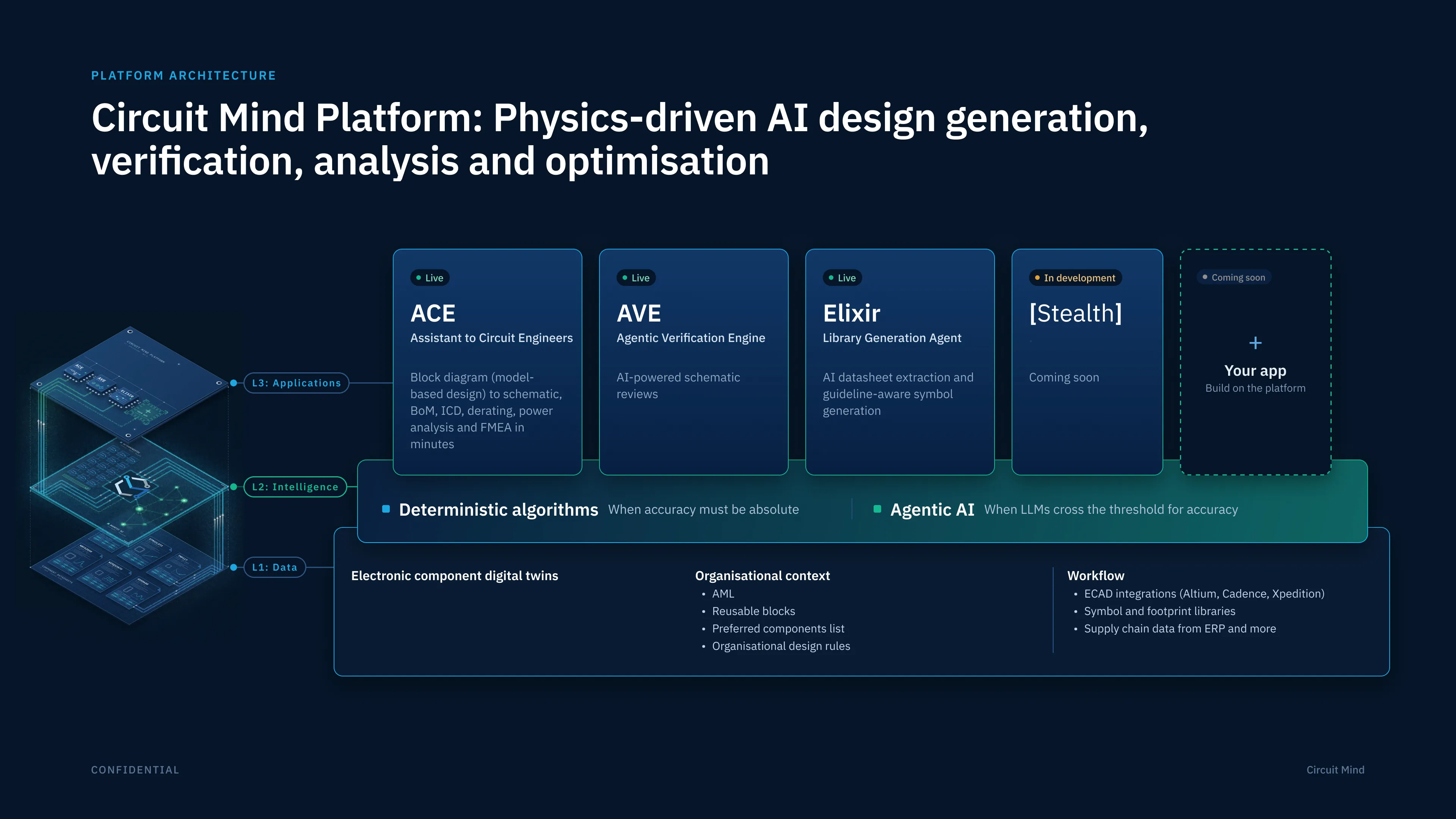
Circuit Mind’s electronics design intelligence platform powers a suite of AI applications, starting with ACE and AVE, that enterprise engineering teams use to generate, verify, optimize, and analyze complex hardware designs. It combines agentic AI with Circuit Mind’s patented physics-based design decision intelligence, digital twins of electronic components, and each customer’s own engineering standards and context, so teams can rely on what it produces.
ACE, Circuit Mind's design generation application, allows engineers to specify requirements as an architecture block diagram and generate a complete schematic, bill of materials, and supporting analysis documents in minutes. ACE selects components, runs the underlying circuit and power calculations, and optimizes each design for cost, size, power, and supply chain, producing multiple design options for an engineer to compare. Finished designs export directly into the engineering team's existing Electronic Computer-Aided Design (ECAD) tools.
AVE takes on the gate every design has to pass: design reviews. It starts a swarm of AI agents to review a schematic, especially those designed manually in ECAD, against component datasheets, application notes, and the organization's own design rules, catching issues before they derail a project schedule. Some agents work through datasheets, examining pin tables, operating voltages, and other constraints; others trace every connection and bus in the circuit. Before anything reaches the engineer, AVE runs its own quality-assurance pass, critiquing every finding so only the ones that hold up are reported.
Circuit Mind’s platform is already helping engineers turn weeks of design work into hours. In a peer-reviewed case study, the space electronics team at Los Alamos National Laboratory (LANL) evaluated the platform and reported cutting one design’s timeline by more than 90%.
"With increasing pressure to deliver complex hardware designs more efficiently, we were looking for ways to accelerate development while maintaining rigorous engineering standards,” said Charlie Eastberg, Director of Hardware Engineering with Emerson’s process systems & solutions business. “Circuit Mind's ACE and AVE platforms have helped our team move more quickly from system architecture to schematic implementation while also improving design validation and review coverage. By automating time-intensive engineering activities and identifying potential issues earlier in the development process, our engineers can focus more of their effort on critical design decisions and innovation. The result has been improved engineering productivity, stronger design rigor, and greater confidence in product quality."
Circuit Mind's Grounded Approach
General-purpose LLMs on their own do not produce reliable results that professional teams can trust in a process where almost right translates to months of delay.
Circuit Mind’s approach uses agentic AI combined with patented proprietary physics-based algorithms developed specifically for making accurate, optimised circuit design decisions. Circuit Mind combines electronics domain-specific harnesses for LLMs and physics-based algorithms to achieve the provable accuracy that enterprise electronics teams demand.
Circuit Mind has also developed a novel approach for capturing electronic component data in a structured, uniform model so that its AI applications can consistently find and interpret the information needed to make decisions and take the correct action in a consistent, reliable way.
Circuit Mind Is Building Toward the Full Design Lifecycle
ACE and AVE cover generation, optimization and verification of schematics. But Circuit Mind aims to extend its platform to solve other use cases across the full electronics design lifecycle. The launch follows Circuit Mind's $25 million financing that was announced today. The company plans to put that funding toward expanding its platform across additional stages of the design lifecycle, including existing design analysis, reporting, testing and firmware.
AVE is available now through Circuit Mind's website. Engineering teams can request access or arrange a demo at circuitmind.io. See what our platform can do at circuitmind.io/platform.
You can also meet the Circuit Mind team at Electronica 2026 in Munich, November 10–13, at booth B5.565.
About Circuit Mind
Circuit Mind is an electronic design intelligence platform that generates, verifies, and optimizes hardware designs with provable accuracy, built into the ECAD stack engineering teams already run. Founded by Tomide Adesanmi and Basilio Gentile, Circuit Mind's platform includes ACE, for design generation, and AVE, for design verification, both grounded in a proprietary digital twin data layer and each customer's own engineering context. The company is headquartered in London and backed by Norwest, Episode 1, Third Prime, Differential, Blackhorn, and Lightscape VC. Learn more at circuitmind.io.
Media Contact
BOCA Marketing
circuitmind@bocamarketing.com
A photo accompanying this announcement is available at https://www.globenewswire.com/NewsRoom/AttachmentNg/ac6c10ca-011a-4d6d-bef0-d080dd879325







Comments (0)
Login to join the conversation
Login / RegisterNo comments yet. Be the first to comment!