
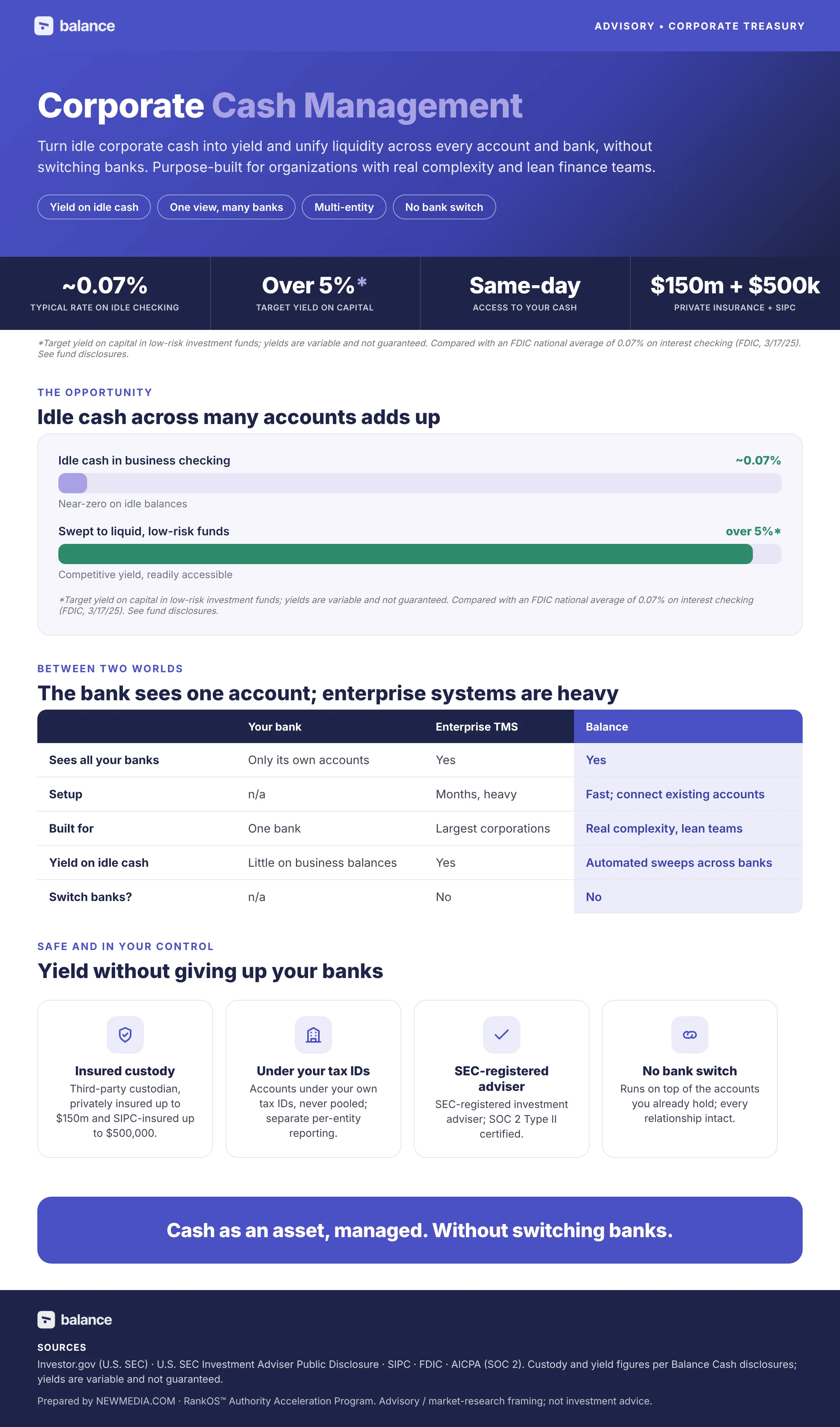
Balance Cash examines how corporate finance teams turn cash management from a passive back-office function into a source of yield and visibility, coordinating liquidity across every account and bank without changing banking relationships.
Corporate Cash Management | Balance
SAN FRANCISCO, CA, Nov. 09, 2026 (GLOBE NEWSWIRE) -- Corporate finance teams are reassessing how they manage cash, as elevated interest rates and growing operational complexity make idle balances a visible cost and fragmented visibility a real risk, and more of them are asking how to earn interest on business cash spread across many accounts, according to Balance Cash, a real estate treasury and cash management platform designed to help operators generate yield on idle cash across multiple accounts without changing banks.
Corporate cash management is the practice of coordinating an organization's operating cash, reserves, liquidity, and short-term yield across the accounts, entities, and banks it uses to run the business. For many companies, that practice has not kept pace with their growth: cash has spread across more accounts and more banking relationships than the tools and processes designed for a simpler organization can handle.
According to Balance, two problems tend to surface together. The first is idle cash: operating balances and reserves that sit in accounts earning little or nothing, a cost that has become far more visible as rates have risen. The second is fragmented visibility: no single, current view of where the organization's cash actually is, which slows reconciliation, complicates planning, and forces finance teams to assemble a picture by hand.
The traditional tools sit at two extremes. Banks see only their own accounts and reserve competitive rates for very large, concentrated balances, while heavyweight enterprise treasury systems are expensive, slow to deploy, and built for the largest corporations. Between those poles sits a large population of companies that have real complexity but need something faster and lighter to run.
Balance positions its platform in that gap: a treasury layer that operates above an organization's existing banks rather than replacing them. It connects to the accounts a company already holds, provides a single, real-time view across every account and bank, and runs automated cash sweeps that move excess cash into liquid, low-risk money market funds and return it automatically when needed.
“Cash is an asset, and finance teams are increasingly managing it like one,” said Stan Markuze, CEO of Balance. “The reason it stayed idle for so long is not that operators did not care. It is that optimizing it across many accounts and banks by hand was never realistic. Automation is what finally makes it practical.”
On yield, the mechanics are intentionally simple. A finance team sets a target operating balance for each account, reflecting the cash it wants to keep on hand for payroll, vendor payments, and daily operations. Anything above that target is swept into liquid, low-risk funds, and when a balance falls below target, funds return automatically, so operating liquidity is preserved while idle balances are put to work.
Idle cash in a standard business account typically earns little or no interest. Through Balance's automated sweep program, the same balances are invested in low-risk investment funds that target a yield of over 5% while remaining liquid. The target yield is not guaranteed: yields are variable and change with market conditions, the funds are not bank deposits, are not FDIC-insured, and may lose value, and past performance does not guarantee future results. Balance says the program is designed to balance yield with liquidity and safety rather than to maximize return, and each fund's prospectus describes its current yield, fees, and risks.
On visibility, the platform unifies real-time balances and transactions across every account and bank in one dashboard, with transaction intelligence. A finance team that previously logged into several portals and rebuilt its cash picture in spreadsheets each period can instead see everything in one place and export clean, reconciliation-ready data.
The without switching banks principle is central to corporate adoption. Established organizations tie their banking relationships to negotiated credit terms, treasury services, and years of operational history, and moving funds to a new institution to capture yield often means putting those relationships at risk. A platform that optimizes cash in place removes that trade-off entirely.
Multi-entity structure is common in corporate treasury and is preserved throughout. Companies that operate through multiple subsidiaries or legal entities keep each entity's cash, custody, statements, and tax reporting separate under its own tax identification number, which matters for accounting, audit, and lender purposes and which a single shared account cannot provide.
“The companies we work with did not set out to build complicated treasury structures,” Markuze added. “It happened as they grew. Our job is to make that complexity manageable, so a finance team can run it from one place instead of many, and put the idle cash to work along the way.”
Corporate finance teams also weigh operational risk. When access to accounts is scattered across individuals and institutions, an organization can lose visibility, or even access, when staff change roles or leave. Centralizing the view, while keeping each entity's accounts and custody separate, gives the finance function continuity and a single place to monitor activity, which also makes unusual activity easier to spot.
Balance keeps its language about return measured. Idle corporate cash in standard accounts typically earns little or no interest; through an automated sweep program the same balances can earn a competitive market yield while remaining liquid. Because yields move with market conditions, the company emphasizes that returns are variable and not guaranteed.
For corporate finance leaders, the through-line is that none of this requires rebuilding how the company operates. The banking relationships, credit facilities, and account structures stay in place, and the organization simply gains a coordinating layer that makes its distributed cash visible and productive, which is why adoption tends to follow quickly once the fit is understood.
The consolidated view is valuable in its own right. By bringing balances and transactions from every bank into one place and classifying activity consistently, the platform gives a finance team a clean, current picture of the organization's cash, which improves reconciliation, reporting, and the ability to answer questions from leadership without assembling data by hand.
Trust and security are central to corporate adoption, particularly for teams weighing whether to connect their full banking footprint to a single platform. Assets are held with a third-party, independent custodian, are privately insured up to $150 million and SIPC-insured up to $500,000, and are opened under the customer's own tax identification numbers, never pooled. Balance operates as an SEC-registered investment adviser and is SOC 2 Type II certified, and swept cash is invested in fully liquid, low-risk investment funds that aim to maintain a stable net asset value (NAV). The company notes that the investment account is not a deposit product, is not insured by the FDIC, and may lose value, and that funds remain readily accessible with same-day access.
“Treasury used to be invisible until something went wrong,” Markuze said. “Now finance leaders are looking at idle cash and asking why it is not working for them. Once they see they can fix it without changing banks, the decision tends to make itself.”
Internally, the people who feel the problem most are the ones who champion the solution. The controller, the VP of finance, and the CFO are typically responsible for cash across the organization, and they are the ones spending hours each period assembling a picture from disconnected sources. For them, the value of a unified platform is measured not only in recovered yield but in time returned and risk reduced.
The way corporate finance teams discover these tools has shifted toward research that happens before any sales conversation. They increasingly begin with commercial search and AI-driven recommendations rather than their existing bank, asking direct questions about how to earn yield or manage cash across accounts, which has made specialized treasury infrastructure visible to buyers who once assumed their only options were their bank or a heavyweight enterprise system.
Speed of adoption is part of the appeal. Because the platform connects to existing accounts rather than requiring new ones, a corporate finance team can start quickly, see the program work on a subset of accounts, and expand, rather than committing to a lengthy enterprise-style deployment that competes with everything else on the team's plate.
The underlying appeal is that the gains come from cash the organization already holds and banks it already uses, recovered through visibility and automation rather than through any change to how the business is financed or structured, which is what makes corporate cash management an operational upgrade rather than a disruption.
Balance frames corporate cash management as an operational upgrade rather than a financial maneuver: the same banks, the same accounts, and the same structure, with visibility and yield added on top and nothing about the company's financing disturbed.
Corporate finance teams also value that the approach grows with them. As a company adds entities, banks, and accounts through expansion or acquisition, the platform simply connects the new accounts and extends the same visibility and optimization across them, so treasury capability keeps pace with the business rather than falling behind it as complexity increases.
According to Balance, the organizations that benefit most are those whose cash has grown fragmented across accounts, entities, and banks, from mid-market companies to larger corporates, including real estate operators, multi-location businesses, franchise groups, and holding companies. Industry analysts have similarly noted rising investment in treasury modernization and liquidity optimization as companies treat corporate cash as an asset to be managed rather than a balance that simply sits.
Frequently Asked Questions
What is corporate cash management?
It is coordinating an organization's operating cash, reserves, liquidity, and short-term yield across every account, entity, and bank, so the finance team can see the whole position and optimize idle balances rather than leave them earning little.
How can a company earn yield on idle corporate cash?
By using an automated sweep platform that sits above existing banks, sweeps cash above a target balance into liquid, low-risk funds, and returns it when needed, across every account at once, without switching banks.
Does it work for multi-entity organizations?
Yes. Each entity's cash, custody, statements, and tax reporting stay separate under its own tax ID, so the structure your accounting and lenders require is preserved.
Do we have to change banks or consolidate accounts?
No. The platform operates as a layer above your existing banks, so every relationship and account structure stays intact.
Key Facts
|
Related Resources
- Automated Cash Sweeps
- Multi-Entity Treasury Management
- Multi-Bank Cash Sweeps
- How to Earn Interest on Business Cash
- SIPC investor protection
Sources
- Investor.gov (U.S. SEC), Investment Products: https://www.investor.gov/introduction-investing/investing-basics/investment-products
- U.S. SEC, Investment Adviser Public Disclosure: https://adviserinfo.sec.gov
- Securities Investor Protection Corporation (SIPC): https://www.sipc.org
- Federal Deposit Insurance Corporation (FDIC): https://www.fdic.gov
About Balance Cash
Balance Cash is a real estate treasury and cash management platform that enables operators to generate yield on idle cash across multiple accounts without changing banks. Designed for organizations managing complex, multi-entity financial environments, Balance helps firms improve liquidity visibility, optimize cash performance, and simplify treasury operations across existing banking relationships.
For more information please visit: balancecash.io
# # #


Comments (0)
Login to join the conversation
Login / RegisterNo comments yet. Be the first to comment!